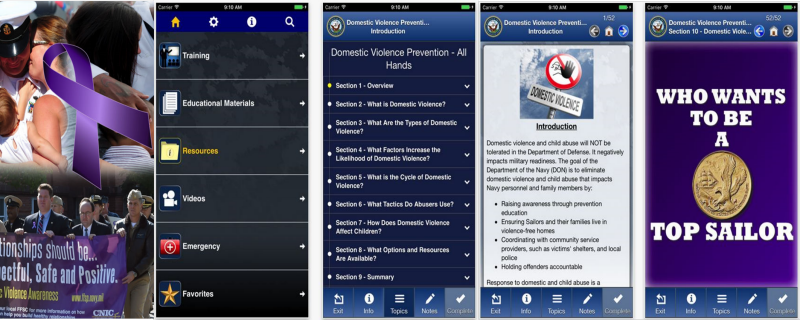
Domestic Violence Prevention (DVP) Training Mobile Application - The Navy’s DVP app is a mobile training and resource tool that provides easy access to information and training that satisfies the Navy’s General Military Training (GMT) requirements for Domestic Violence Prevention.
The training module within the DVP app is designed to satisfy the following learning objectives:
- Define domestic violence
- Identify the types of domestic violence
- Identify some factors associated with becoming an abuser
- Identify the three phases within the cycle of domestic violence
- Identify some tactics used by abusers in domestic violence cases
- Identify some ways domestic violence affects children
Once training is completed, the app allows the user to document completion of their GMT training completion requirements in the
Electronic Training Jacket (ETJ) using their
DoD ID number. This feature supports the Navy’s ongoing efforts to provide Sailors with “anytime/ anywhere” access to information and ability to complete training requirements when it’s convenient to them.
NOTE: To successfully submit a course completion from an NMCI-issued mobile device, an external e-mail account must be set up.
In addition to the training, the app provides links to key DVP resources. This includes an “Emergency” contacts section that is available to the user 24/7, such as the National Domestic Violence Hotline and Military Crisis Line. This quick and easy access to resources makes it ideal for Sailors of all ranks.
The DVP app aggregates information from a variety of sources. Please be aware that some of the information contained in the app may be out of date or no longer valid. Information will be checked periodically for accuracy and updated as needed and released via periodic DVP version updates.
Download the app from the
Apple iTunes App Store or
Google Android App Store.
Family Advocacy Program (FAP) Domestic and Child Abuse Resources
- Centers for Disease Control and Prevention - Intimate Partner Violence, Understanding Intimate Partner Violence Fact Sheet
- Domestic Abuse Victim Advocate at your local installation’s Fleet and Family Support Center
- The National Domestic Violence Hotline at 1-800-799-7233 or 1-800-787-3224 (TTY) is available 24 hours a day for safety planning and referrals for local resources visit http://www.ndvh.org/
- Military OneSource - https://www.militaryonesource.mil/
- Military One Source Domestic Abuse Victim Advocate Locator (DAVA Locator) https://go.usa.gov/xtKE7
- National Dating Abuse Helpline - 1-866-331-9474, www.loveisrespect.org
- Pathways to Safety International - International Toll-Free (24/7), https://pathwaystosafety.org/
- National Child Abuse Hotline/Childhelp - 1-800-4-A-CHILD (1-800-422-4453), www.childhelp.org
- National Sexual Assault Hotline - 1-800-656-4673 (HOPE), www.rainn.org
- National Suicide Prevention Lifeline - 1-800-273-8255 (TALK), www.suicidepreventionlifeline.org
- National Center for Victims of Crime - 1-202-467-8700, www.victimsofcrime.org
- National Human Trafficking Resource Center/Polaris Project - Call: 1-888-373-7888 | Text: HELP to BeFree (233733), www.polarisproject.org
- National Coalition for the Homeless - 1-202-737-6444, www.nationalhomeless.org
- National Resource Center on Domestic Violence - 1-800-537-2238, www.nrcdv.org and www.vawnet.org
- Futures Without Violence: The National Health Resource Center on Domestic Violence - 1-888-792-2873, www.futureswithoutviolence.org
- National Center on Domestic Violence, Trauma & Mental Health - 1-312-726-7020 ext. 2011, www.nationalcenterdvtraumamh.org
Children
Teens
Family Advocacy Program (FAP) Problematic Sexual Behavior in Children and Youth Resources
- FAP and Resource Guide for Parents and Caregivers: PSB-CY: This Military OneSource article outlines the Department of Defense's official program for addressing problematic sexual behaviors in children, explaining the supportive, multi-disciplinary approach used to assess risk and provide treatment for military families.
- Caregiver Engagement in Cases of PSB-CY- Podcast: Listen to this MilitaryOneSource podcast to learn about the different degrees of problematic sexual behavior in children and youth, the stigma surrounding PSB-CY and the barriers that might prevent a caregiver from asking for help. You’ll also learn strategies for caregivers who are concerned about a child exhibiting PSB, as well as tips for clinicians when preparing for meetings regarding an incident.
- Child Sexual Behaviors: This Military OneSource article provides parents and caregivers with guidance on the stages of healthy sexual development, helping them distinguish between normal childhood curiosity and potentially problematic behaviors while offering advice on how to respond...
- National Center on the Sexual Behavior of Youth: This website provides information from a variety of sources about the management of PSB-CY.
- OneOp: Readiness. Knowledge. Network: This website has a variety of webinars that address different topic areas related to sexual behavior in children and youth. Each is free to attend, available for replay viewing, and offers continuing education credit and certificate of attendance options.
Differently Abled
Updated 7 April 2026